|
Degrees:
Ph.D., Univ. at Albany-SUNY
M.A., Marquette Univ.
B.A., Univ. of Wisconsin-Milwaukee
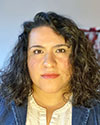
Diana Aldrete is an Assistant Professor of Language and Culture Studies and Human, as well as a visual artist based in Hartford, CT. Her research, pedagogy, and artistic practice, interrogate the intersections of contemporary Mexican, Latin American, and Latinx literary and cultural studies; Mexico-U.S. border studies; feminist and queer theory; environmental humanities; and human rights studies.
She is a recipient of the 2025-26 American Postdoctoral Research Fellowship from the American Association of University Women (AAUW) which supports the completion of her manuscript, Between Land and Death: Women Writing for Justice in Mexico. The project examines how literary production, primarily by contemporary Mexican women writers, has become part of the political dialectic on anti-feminicidal violence, questioning notions of justice and placing literature in conversation with political discourses and forms of activism.
Aldrete’s scholarly and creative work explore themes of violence, erasure, and ecological interconnection across literary and visual media. She has published poetry and short fiction, and her visual art has been exhibited in several venues throughout Connecticut. Her first solo exhibition, Invisible Suffering (2022), supported by the Free Center’s “Independent Artist Fund,” interrogates the historical resonance of unseen suffering in the year 2020. Her current art project, Ech.o Locations, examines the ecologies of the Great Lakes and the relationships between water, land, and their human and non-human inhabitants. Integrating field research, visual anthropology, sound studies, and visual art (photography and painting), the project underscores the urgent need to protect freshwater ecosystems.
Professor Aldrete has had experience teaching at different levels of higher education, such as community college, small liberal arts college, and research university. This experience has helped her develop an interdisciplinary methodology in her pedagogy. |
-
Contemporary Mexican Literature and Cultural Studies
-
Human Rights Narratives in Latin America
-
Latin American Film Studies
-
Spanish Conversation and Composition
|
FYSM-177
|
Visualizing Human Rights: Art, Images, and Social Justice
|
|
HISP-270
|
Introduction to Cultural Analysis
|
|
HISP-401
|
Senior Seminar
|
|
HRST-312
|
The Question of Justice and Visual Arts Accounting for Truths at Times of Trauma
|
|
HRST-316
|
Ecofeminism, Intersectional Environmentalism, and Human Rights
|
|
-
Human Rights Narratives in Latin America
-
Globalization in Latin American Literature
-
Representations of Violence in Latin American Literature and Film
-
Latin American Film Studies
-
Contemporary Mexican Literature and Culture
-
20th and 21st Century Mexican and Latin American Narrative
-
Narrative Connections Between Text and Visual Arts in Latin America
-
Queer and Latinx Identities in Latin America's Modern Cultural Production
|
ACADEMIC PUBLICATIONS
Manuscript in Preparation - Between Land and Death: Imagining Justice for Women in Mexico. In preparation for submission.
Peer-Reviewed Publications - Aldrete, Diana. “The Ruins of Modernity: Synecdoche of Neoliberal Mexico in Roberto Bolaño’s 2666.” Ecofictions, Ecorealities and Slow Violence in Latin America and the Latinx World, edited by Ilka Kressner, Ana María Mutis, and Elizabeth Pettinaroli, Routledge, 2019, pp. 74-91.
CREATIVE WORK
Short Stories - Manuscript: The Return. In preparation for submission.
- “The Reel.” Powerful Latinas Rising. Apr. 21, 2020. https://powerfullatinasrising.org/the-reel/
- “Los charales.” Diálogo: an Interdisciplinary Studies Journal. 22.2 (2019): pp. 125-29.
- Poetry
“On the Car Ride Home.” Somos en escrito. Jan. 2, 2022.
- Visual Art
Featured painting: “Ice Cave.” Kaleidoscope. 1.1 (2021): p. 10.
Literary translations - Children’s Book: Mi mamá fue guerrillera / My Mom Was a Guerrillera by Ivonne Carlos. Trans. Diana Aldrete. Editorial Gafas Moradas. Forthcoming, 2022.
Interviews and Articles
ARTIST EVENTS, PUBLIC COLLABORATIONS, AND INTERVIEWS Solo Exhibits - Invisible Suffering. Funded by Free Center’s “Independent Artist Fund.” March 11th – April 5th, 2022. Charter Oak Cultural Center, Hartford, CT.
- Invisible Suffering. Sponsored by the Human Rights Studies and Trinity Arts Initiatiative. May 2nd - May 6th, 2022. Austin Arts Center, Trinity College, Hartford, CT.
Group Exhibitions - 2021 Pride Virtual Art Show. Sponsored by the New London Pride. New London, CT. Aug. 16, 2021.
- “Ice Cave.” Queer One Show (OPEN wALL ed. 02). Sponsored by the Free Center. Middletown, CT. Feb. 14, 2021.
- “Jazz.” Safe Spaces ed. 01. Sponsored by the Free Center. Middletown, CT. Oct. 23, 2020.
- 2020 Pride Virtual Art Show. Sponsored by the New London Pride. New London, CT. Aug. 10, 2020.
- “Pride.” Art2Unite2. Sponsored by ArtSpace. Hartford, CT. Jun. 22, 2019.
Poetry Performances - Honoring Latina Poets in CT. Sponsored by the Hartford Public Library and Margaret Gibson, CT Poet Laureate. Hartford, CT. Oct. 23, 2021.
- “Say Her Name.” NEA’s Big Read Kickoff. Sponsored by the Hartford Public Library. Hartford, CT. Feb. 28, 2021.
- A Little Bit of Death V (Cast member – musical and poetry performance). Sponsored by the Long Wharf Theater. New Haven, CT. Dec. 9, 2020.
- Featured reciter of Poetry from Clara Lair and Julia de Burgos: Music and Poetry of the Extended Caribbean. Sponsored by the Center for Latino, Latin American and Caribbean Studies (CELAC); University at Albany, SUNY. Albany, NY. March 2015.
- Director of the play: Coser y cantar by Dolores Prida. Proving Brevity. Sponsored by the Department of Languages, Literatures and Cultures; University at Albany, SUNY. Albany, NY. November 2007.
Collaborations - “Flow.” Coming Home: A Hartford Collage. Sponsored by Cuatro Puntos. Hartford, CT. Feb. 21, 2021.
- “Warm Embrace.” Cross-Atlantic Quarantine Sessions. Sponsored by Cuatro Puntos. Hartford, CT. Apr. 25, 2020.
- Coordinator: “LLC’s Evening of the Arts.” Sponsored by the Department of Languages, Literatures and Cultures; University at Albany, SUNY. Albany, NY. February 2015.
Featured Interviews PUBLIC INVITED TALKS - “Towards Healing: A Conversation on The Exhibit Invisible Suffering with Dr. Diana Aldrete.” Sponsored by Charter Oak Cultural Center. Hartford, CT. March 17, 2022.
- “The Effects of Immigration Policies on Women.” Moderator. Seminar Series: Gender/Sexuality Matters. Sponsored by Women’s and Gender Studies; Vanderbilt University. Nashville, TN. Nov. 6, 2018.
“Day of the Dead and Coco”.
- 16th Annual Spanish Language Film Festival. Sponsored by University of Saint Joseph. West Hartford, CT. Sept. 18, 2018.
CAMPUS AND DEPARTMENTAL TALKS - “Invisible Suffering.” Fall Series. Sponsored by the Trinity College Social Justice Initiative. Hartford, CT. Nov. 9, 2021.
- “The Experiences of Latinx Professors in Higher Education.” Café con Leche. Sponsored by La Voz Latina; Trinity College. Hartford, CT. Nov. 8, 2019.
- “Imagining Justice for Women of Feminicides.” Department of Language and Culture Studies Lecture Series. Trinity College. March 26 2019.
- “Women’s Bodies in the Global Community.” Sponsored by Promoting Healthy Awareness of the Body (PHAB) and Women and Gender Resource Action Center (WGRAC); Trinity College. Hartford, CT. Nov. 27, 2018.
- “Women in Juarez.” Café con Leche. Sponso
|
- 2025-26 American Postdoctoral Research Fellowship from the American Association of University Women (AAUW); Book project: Between Land and Death: Women Writing for Justice in Mexico.
- “Independent Artist Fund” Recipient; Art project: Invisible Suffering, FreeCenter, 2021.
- Faculty Research Grant Recipient, Trinity College, 2019-2020.
- Faculty Fellow, Liberal Arts Action Lab. Community project: "Latinx Theater." Trinity College, 2019.
- Faculty Fellow, Center for Teaching and Learning. Pedagogical project: "Building Empathy in the Classroom Through Literature." Trinity College, 2018-2019.
- Graduate Student Fellowship, University at Albany, SUNY, 2006-2008.
- Graduate Student Fellowship, Marquette University, 2003-2005.
- Scholarship Recipient, Hispanic Scholarship Fund, 2003 and 2005.
- Scholarship Recipient, Hispanic Professionals of Greater Milwaukee (HPGM), 2004.
|
|
|